How SEO and Web Design Work Together to Grow Businesses in Kenya
The Structural Relationship Between SEO and Web Design
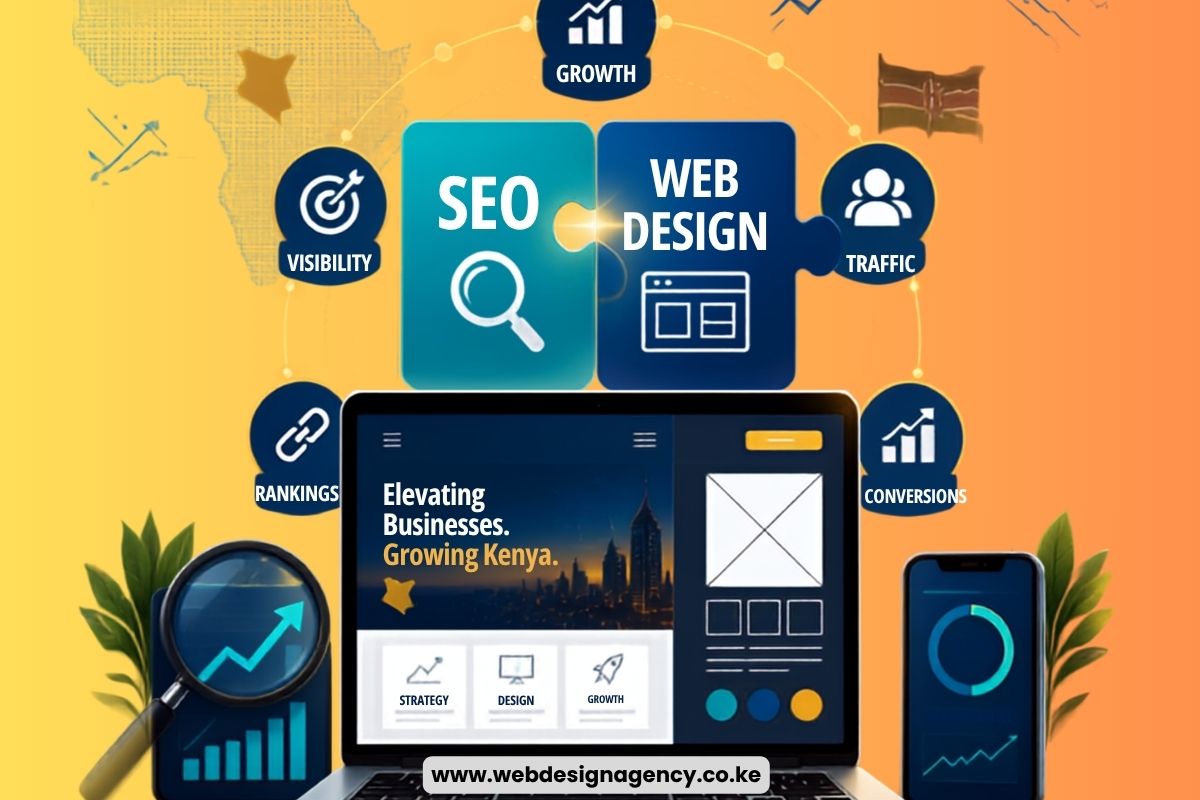
SEO and web design are not separate disciplines operating in isolation. Instead, they function as interdependent layers of the same digital ecosystem. On one hand, web design determines how users interact with a website; on the other hand, SEO determines how users discover it. Therefore, when one layer is weak, the entire system underperforms.
To illustrate this relationship more clearly, the interaction between design and SEO can be broken down into a performance model:
| Web Design Element | SEO Function Impact | Business Outcome |
|---|---|---|
| Site architecture and navigation | Crawlability and indexing efficiency | Higher search visibility |
| UX layout and page structure | Engagement signals such as bounce rate and dwell time | Improved rankings |
| Visual hierarchy and formatting | Content clarity and keyword emphasis | Stronger user retention |
| Mobile responsiveness | Mobile-first indexing compliance | Increased organic traffic |
| Page speed optimization | Core Web Vitals performance | Higher conversion rates |
| CTA placement and design | Behavioral interaction signals | Increased leads and sales |
From this model, it becomes clear that design decisions directly influence SEO signals, and SEO signals directly influence revenue performance.
Why Most Websites in Kenya Fail at SEO and Design Integration
Many businesses in Kenya approach web development in two disconnected phases: first, they build a website focused on visuals, and then they attempt to “add SEO” afterward. This fragmented approach consistently produces structural inefficiencies that limit performance.
This failure typically occurs due to several recurring issues:
- Websites are designed without considering SEO architecture
- Content is added without aligning to user search intent
- Heavy themes slow down performance significantly
- Keyword structure is not mapped to page hierarchy
- Internal linking is weak or inconsistent
As a result, businesses end up with websites that may look professional but fail to attract organic traffic, retain users, or generate meaningful conversions. Ultimately, this leads to wasted investment and underwhelming digital returns.
How SEO Should Influence Web Design From the Start
High-performing websites are not corrected after launch; rather, they are strategically engineered for SEO during the design phase itself. This proactive approach ensures that visibility and performance are built into the foundation rather than patched later.
Effective integration begins with the following principles:
- Keyword research defines the site structure before design begins
- Content architecture is aligned with search intent early in planning
- URL structures are created alongside navigation systems
- Mobile-first design is prioritized before desktop refinement
- Performance optimization is embedded into the development framework
When these principles are applied correctly, every design decision actively supports indexing, ranking, and visibility. Therefore, businesses avoid costly redesigns and technical restructuring in the future.
How Web Design Strengthens SEO Performance
While SEO is responsible for driving traffic, web design determines what happens after the user arrives. In other words, SEO attracts users, but design decides whether they stay, engage, or leave.
Several design factors directly enhance SEO performance:
- Clean layouts reduce cognitive overload and improve engagement time
- Optimized visuals improve loading speed and Core Web Vitals scores
- Structured content improves readability and keyword emphasis
- Strategic CTA placement influences user behavior and interaction patterns
In turn, search engines interpret these engagement signals as indicators of content quality. Consequently, a well-designed website indirectly strengthens SEO rankings by improving user behavior metrics.
SEO vs Web Design vs Integrated System Performance
The difference between isolated execution and integrated strategy becomes evident when performance outcomes are compared side by side.
| Approach | Traffic Performance | User Experience | Conversion Rate | SEO Stability |
|---|---|---|---|---|
| Web design only | Low organic visibility | Strong visuals, weak structure | Low | Weak |
| SEO only | High traffic potential | Poor usability | Moderate to low | Unstable |
| Integrated SEO + Web design | High and consistent traffic | Seamless user journey | High | Strong and sustainable |
This comparison clearly shows that integration consistently outperforms isolated strategies because it aligns discovery, interaction, and conversion into one continuous system.
Technical Layer Where SEO and Design Intersect
Beyond visuals and content, there is a technical foundation where SEO and web design intersect deeply. This layer determines how efficiently search engines can access, interpret, and rank a website.
Key integration areas include:
- Responsive frameworks that support mobile-first indexing
- Clean and optimized code structures for efficient crawling
- Image compression and performance optimization techniques
- Secure HTTPS implementation for trust and ranking signals
- Schema markup integration for enhanced search visibility
When these technical elements are implemented correctly, they significantly improve how search engines evaluate and display website content.
Conversion Architecture: Where SEO Meets Revenue
The ultimate purpose of integrating SEO and web design is not simply to generate traffic, but to convert that traffic into measurable business outcomes. Without conversion architecture, even high-ranking websites fail to deliver revenue impact.
This system operates through a structured flow:
- SEO attracts users based on search intent
- Web design guides users through structured navigation paths
- UX design reduces friction during decision-making
- CTAs convert engagement into leads, inquiries, or sales
However, when either SEO or design is missing, the system breaks. SEO without design leads to traffic leakage, while design without SEO leads to invisibility. Therefore, only integration creates a stable conversion ecosystem.
Let’s Build a High-Performance SEO and Web Design System for Sustainable Growth in Kenya
Many businesses in Kenya continue to lose revenue opportunities because SEO and web design operate in isolation, resulting in websites that either attract traffic without conversions or look visually strong but fail to rank on search engines. This structural disconnect weakens user experience, reduces organic visibility, and limits long-term scalability in an increasingly competitive digital environment. When SEO and web design in Kenya are strategically aligned, businesses unlock a unified system that improves search rankings, enhances user engagement, and consistently drives qualified conversions. To eliminate these performance gaps and build a fully optimized digital ecosystem, partner with us for integrated SEO and web design solutions designed for measurable business growth and sustained online competitiveness.